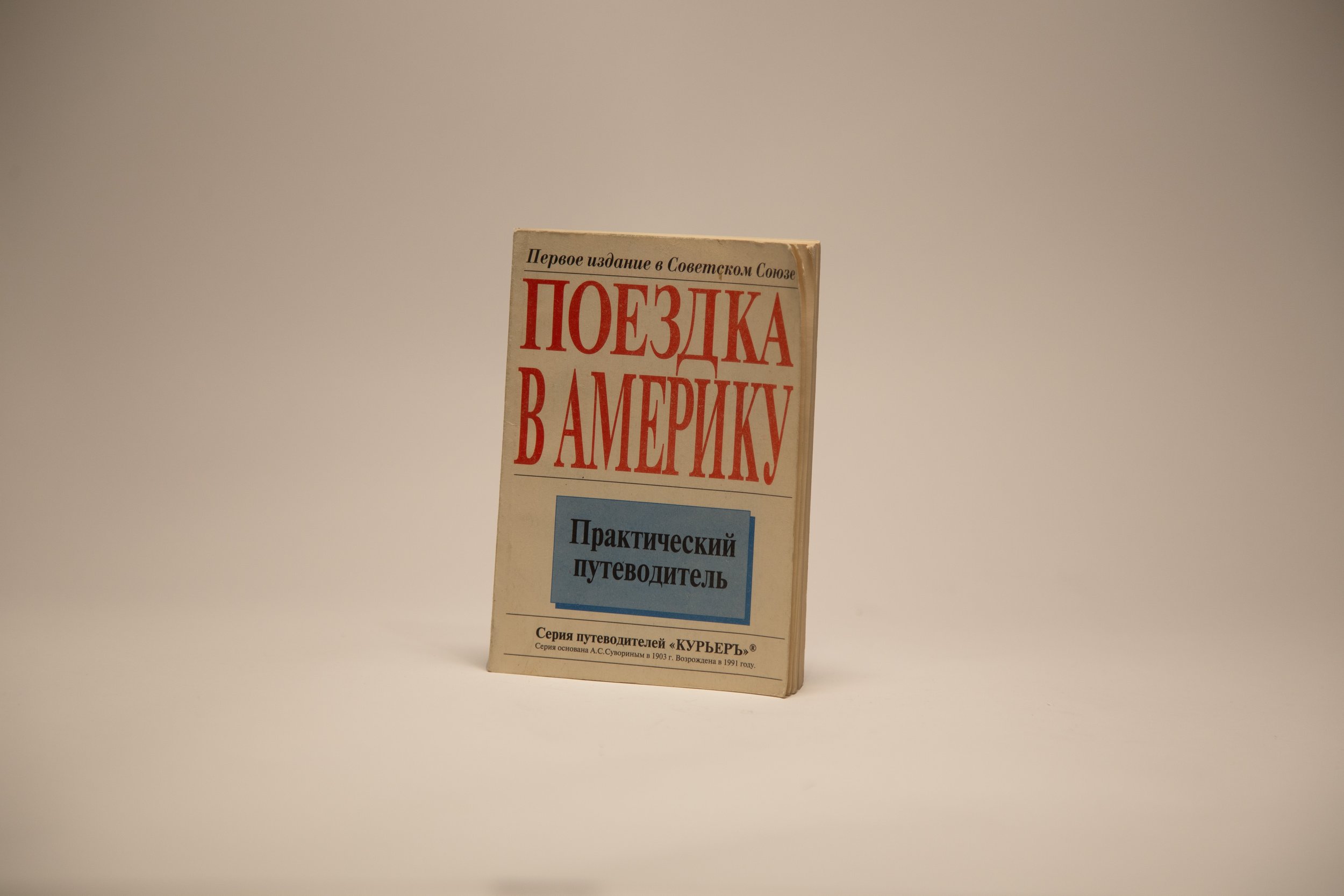
BIBLIOGRAPHIC REFERENCE: Poezdka v Ameriku: Prakticheskiї putevoditel. (Travel to America: A practical guide). INTO, 1991.
Travel opportunities for Russians expanded in the early 1990’s.
By 1991, Soviet citizens would have used this guide for information on how to obtain visas and buy airline tickets to the US (answer: at PAN AM’s Moscow office, Dobryninskaya street, near Oktyabrskaya metro station). The book included information to help understand US culture, such as important holidays, and a list of American historical dates to know, beginning with 1492, when Columbus discovered America, and ending with Jan. 17, 1991, the day of the US invasion of Iraq. It offered advice on how to converse with Americans, warning readers that while smoking, no need to offer a cigarette to another person (“that’s not done here” [in the US]), and never to ask how much someone earns or how they make money. Other than that, it’s possible to talk with Americans about almost any topic. The guide warns readers not to complain about anything, but instead make an effort to be optimistic. The guide warns readers never to discuss illness or “everyday difficulties.”
While the Soviet government was known for controlling its population through passport restrictions, these had eased for Russians by the early 1990’s. Reforms launched in 1986, as part of perestroika, led to changes in economic structures of and set up joint ventures, including ones that provided consumer services in tourism and transportation. “Perestroika, so hopefully launched by economists like Abel Aganbegian, had closed off the possibilities to engage in the kind of leisure mobility that he had celebrated in 1966,” said Koenker. The 1993 Constitution of the Russian Federation guaranteed the “right to rest” as well as the right to travel freely within the country as well as overseas. But even as this became available, it was unaffordable to most by the end of the Soviet regime.
In the 1950’s and 1960’s, previously off-limits places opened to Soviet citizens, including Siberia, the Baltics, Eastern Europe, and western countries. By the mid-1960’s, hundreds of thousands of Soviets had traveled abroad, mostly to Eastern Europe. However, those allowed to travel to “capitalist” countries needed connections and money. For most citizens, the West remained behind the Iron Curtain. Knowledge about foreign countries was confined to literature, Soviet films, radio, travel accounts, and exhibitions that were hallmarks of the Thaw. Soviet leisure travel traditionally focused on medicalized health spas and sightseeing, of natural wonders and attractions, typically available through trade unions.
Previously, Soviet tourism and vacations “emphasized collectivism, culture, education, and civic engagement.” Soviet vacations originated in a “spirit of state purpose” and were meant to be restorative for workers’ health as a way to increase productivity.
Russian-language learners are likely familiar with the adage, which rhymes in Russian, “курица не птица, болгария - не заграница” (Like a chicken is not a bird, Bulgaria is not a foreign country.) This stems from a 1960’s trend of the establishment of health resorts and spas in socialist countries that welcomed Soviet guests, such as Karlovy Vary in Czechoslovakia, Lake Balaton in Hungary, and Varna in Bulgaria.