The best-known Russian folk art form is the wooden nesting doll, the matreshka.
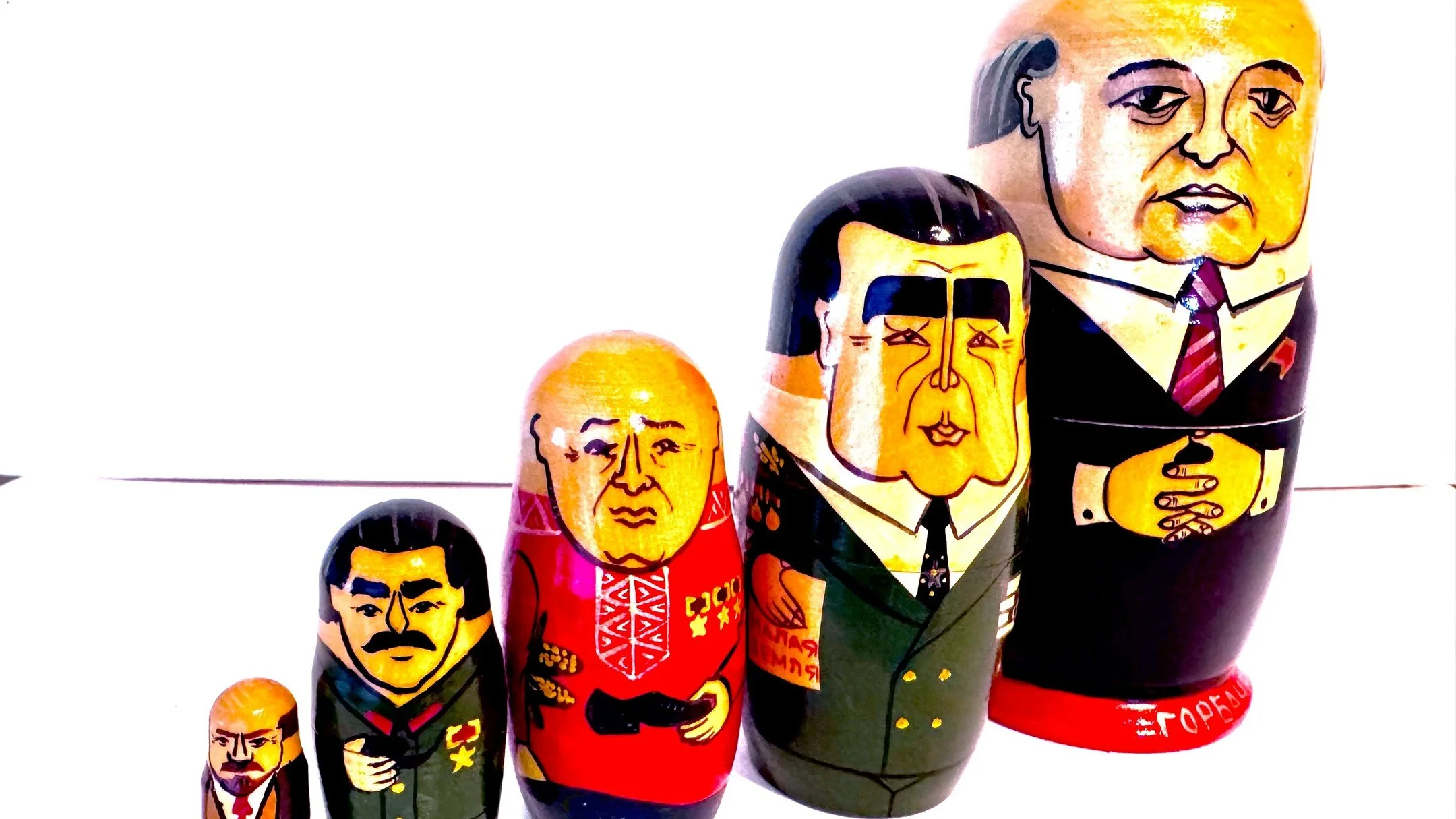
In this matreshka set, Mikhail Gorbachev has primacy, and inside is Leonid Brezhnev, Nikita Khrushchev, Stalin, and Lenin. In Brezhnev’s hand is a book, entitled “Malaya Zemlya” (Little Land), which has a three-fold meaning. It is the site of a World War II battle and anti-Nazi bridgehead where Brezhnev was a veteran; is is an area of the Black Sea port city Novorossiysk rewarded with housing and infrastructure development due to its wartime contribution and battle site; it is one volume of an “autobiography” by the late Soviet leader. The Khrushchev doll holds a shoe to commemorate his 1960 appearance at the United Nations General Assembly in which he banged his shoe against a desk to protest a speech by a member of the Philippines delegation. The Khrushchev doll is also decorated with corn due to the Soviet leader’s efforts to increase the country’s corn crop in an agricultural competition with the United States.
The Gorbachev doll has a port-wine stain on its forehead. Gorbachev is best known for implementing reforms meant to move the Soviet Union toward a market economy. In 1987, a law on Soviet State Enterprises launched market-oriented reforms. Other changes incentivized the creation of small businesses and joint ventures to help solve the problem of inefficient markets and shortages. Changes further accelerated under Yeltsin.
While on vacation, the plotters of the coup detained Gorbachev at his summer home in Crimea. They demanded that security forces take control of Moscow. Boris Yeltsin, who was president of the Russian Soviet Federated Socialist Republic, led resistance against the coup plotters and mounted a barricade in front of the Russian parliament. Army units who refused to fire on civilians soon joined the resistance which won broad public support.
After the coup, Gorbachev was unable to recover his authority. Opposition increased among supporters of a democratic movement against Gorbachev, and in support of Yeltsin, leading to sovereignty of the Russian Federation and the end of the Soviet Union in December 1991, as well as Gorbachev’s resignation.