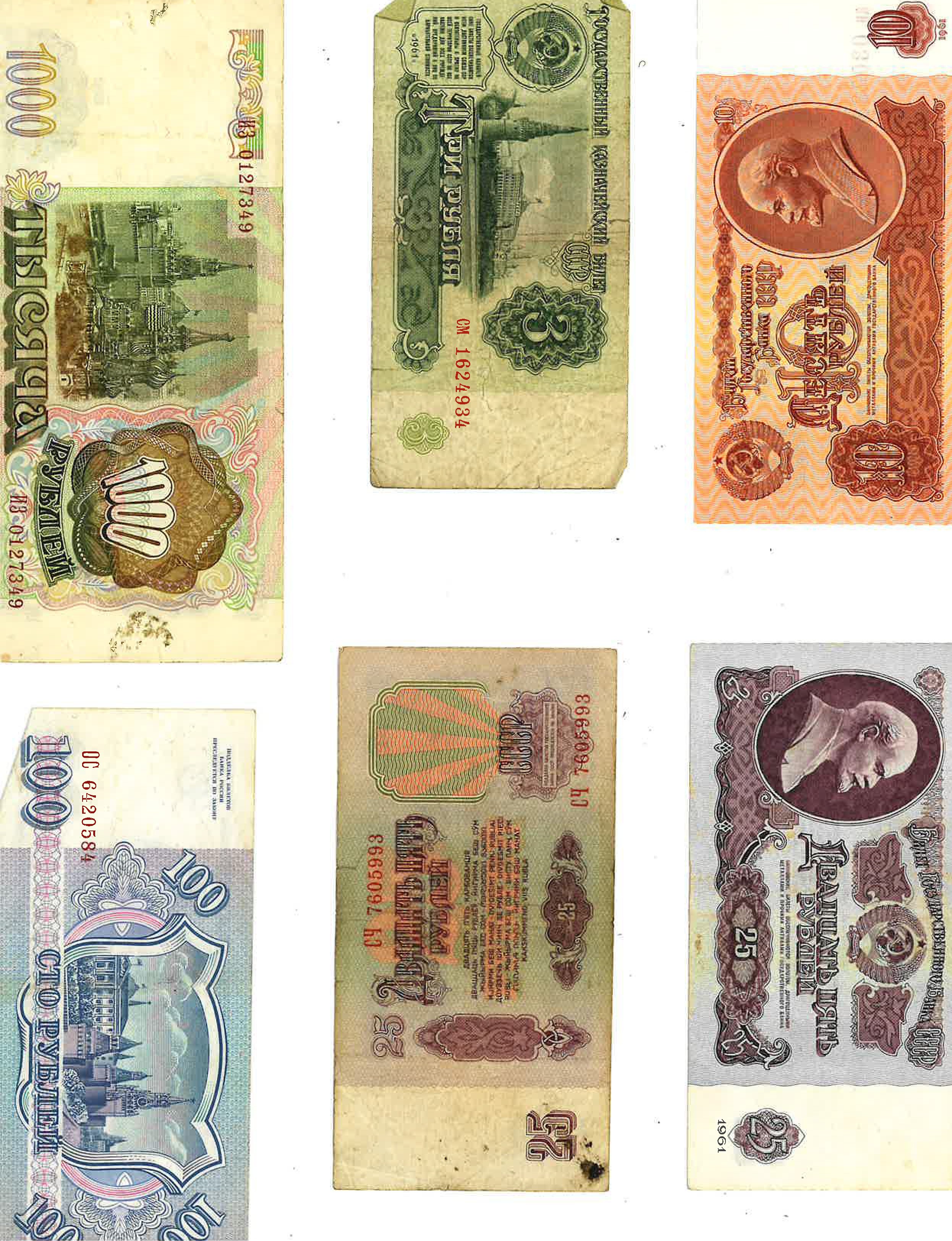
These are examples of paper bills and coins available in 1991-93 in Russia.
Prior to the end of the Soviet Union, the ruble was issued in paper bills denominated in one, three, five, ten, 25, 50, and 100. Kopeks were denominated in one-, two-, three-, five-, ten-, 15-, and 20-coins. In the late Soviet years, the smallest one- and two-kopek coins, needed for public phones, and the 15-kopek coin used in Moscow’s trams, were challenging to find. The kopek was discontinued in the 1990s, then reintroduced in 1998.
In 1992, the government ended price controls and forced state enterprises to find new customers and become self-sufficient. The result was inflation of 2,400 percent in 1992 vs. 1991, while wages rose 1,200 percent. Cash-strapped factories regularly paid workers with the goods the factory produced. A law in 1992 introduced a system of vouchers, allowing individuals to own shares in state enterprises. The flawed system resulted in heavy ownership concentration of company managers and government officials. An unintended consequence of the so-called shock therapy was lack of foreign investment and capital flight, estimated at over $88 billion between 1993 and 1996.
As the ruble depreciated in value, the government issued new bills in 1992, such as 1,000- and 5,000 notes, that eliminated Soviet symbols, such as Lenin in profile, or added abstract ones for the new country.
The fate of the Soviet currency was in question after the end of the Soviet Union, and an early idea circulated for a ruble “zone” with a single, shared currency. In January 1992, all 15 of the Soviet successor states used the ruble. However, during 1992, the three Baltic states and Ukraine issued their own currency, and in 1993, the Kyrgyz Republic, Azerbaijan, Belarus, Georgia, Turkmenistan, Kazakhstan, Uzbekistan, Armenia and Moldova introduced national currencies. That left only war-torn Tajikistan using the Soviet ruble. In July 1993, the Russian Federation introduced Russian banknotes, and declared the former Soviet currency no longer legal tender.