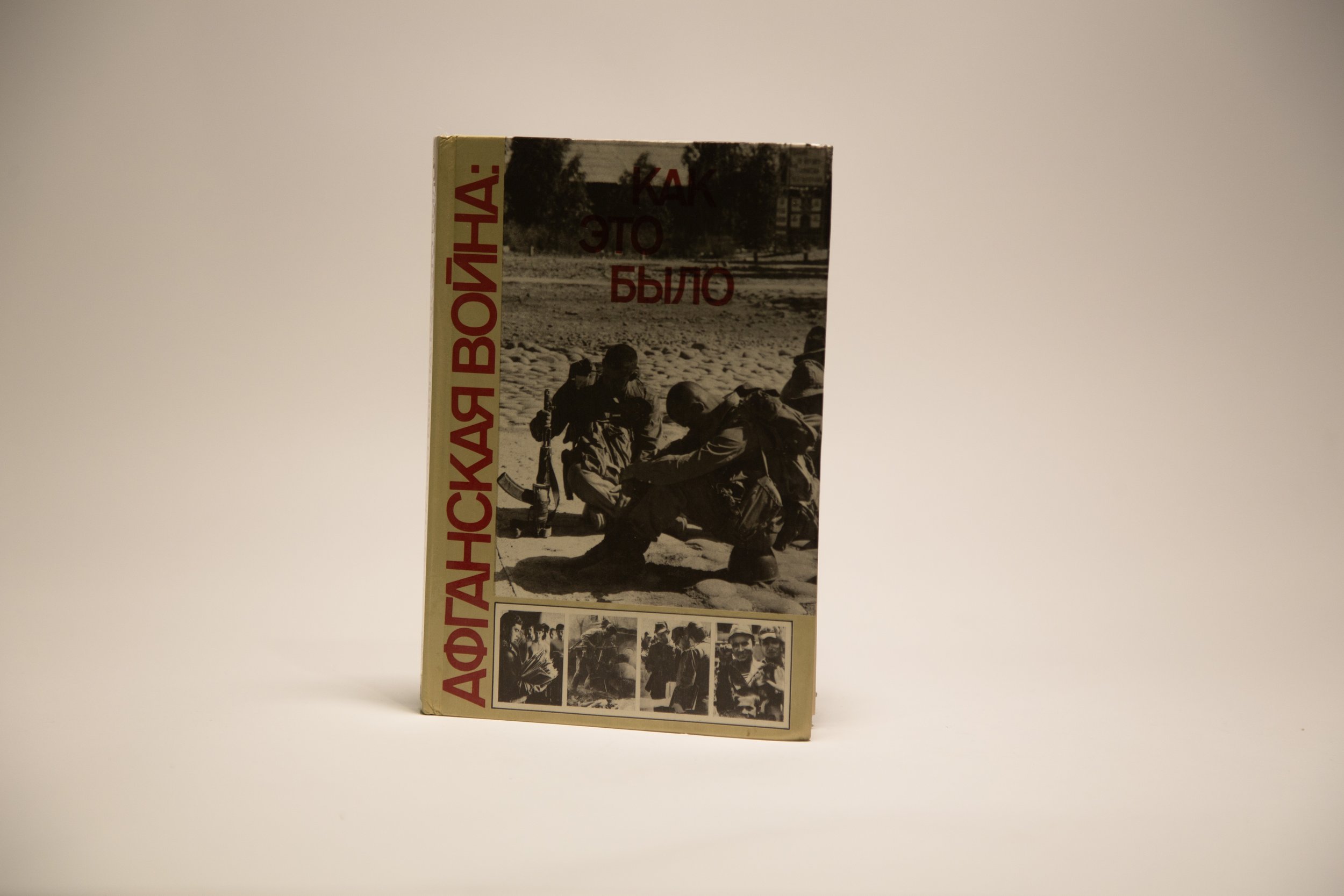
BIBLIOGRAPHIC REFERENCE: Prokhanov, Aleksander Andreevich, and I︠U︡riĭ Veniaminovich Platonov. Afganskai︠a︡ Voĭna: Kak Ėto Bylo: Fotoalʹbom. Planeta, 1991.
In the pre-digital age, this collection of black-and-white and color photos of the 1979-1989 Soviet-Afghan War brought a distant conflict into view of the Russian-language public. The photos include street life in Kabul; local soldiers using Soviet military equipment; hospital wards of wounded; and cemeteries of Soviet casualties. An accompanying text was written by writer and journalist Aleksander Prokhanov, a leading figure in the ultraconservative opposition movement who is now known for anti-semetic and pro-imperialist remarks. In the years just after the Soviet-Afghan War ended, many veterans and writers produced memoirs to document their own experiences in the conflict after official censorship ended. This photobook would have shared shelf space with them.
The Soviet Union’s decade-long conflict in Afghanistan, 1979-1989, is often referred to as the “forgotten” war. The drawn-out military conflict, which ended in retreat for the Soviets, is considered by some a factor that contributed to the collapse of the Soviet Union, while others say it was insignificant in Soviet history. It is sometimes called the country’s Vietnam. The conflict differs from World War II since it did not command a singular, cohesive narrative in Soviet culture.
In a 1986 speech to Congress, Gorbachev referred to Afghanistan as a “bleeding wound,” signaling a turning point when a more critical view entered public discourse. Gorbachev announced the Soviet withdrawal on May 15, 1988. Shortly after, official casualties were announced, with deaths at over 13,000.
After the war ended, the events of the 1990s became the focus of leaders and the population. Since most citizens were not personally affected by the conflict, there was little impetus to judge its success or failure.
Prokhanov arrived in Kabul as a foreign correspondent for Literaturnaia gazeta in 1980, and would have worked alongside other Soviet newspaper correspondents writing about the Soviet military support for Afghan government troops and refuting Western opposition coverage and “propaganda.” Soviet media routinely broadcast Soviet soldiers planting trees and distributing food in Afghanistan, while contraband samizdat publications told of war casualties, crimes, deprivation, and drug addiction among soldiers.
Prokhanov wrote extensively about the Soviet-Afghan War, including as a foreign correspondent and a writer of fiction of lightly-veiled events that resemble his life. A novel in 1982 called Tree in the Center of Kabul brought him fame. Prokhanov generally views the Soviet-Afghan War as a positive, and “incorporates it into his pro-imperialist neo-Eurasianism dogma.”
Prokhanov’s writings about the Soviet-Afghan war generally aligned with the official Soviet view regarding “intervention,” but his later writings questioned Soviet decisions. He was a supporter of the August 1991 attempted coup and of the White House occupiers in the Russian constitutional crisis of September-October 1993. Opposing liberal reforms of the 1990’s, Prokhanov founded the newspaper Den’ which reflects his extreme views, and its successor newspaper Zavtra. He believes Russia should be ruled by a strong leader with nationalist policy. Today, Prokhanov is considered a fascist, often linked to Aleksander Dugin, a spiritual “advisor” for the Kremlin.