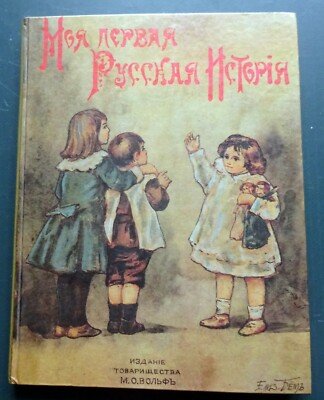
BIBLIOGRAPHIC REFERENCE: Golovina, N. N. Moia Pervaia Russikaia Istoriia. Miloserdie, 1992.
This is a high quality children’s book covering Russian Imperial history, printed in an old-style typeface with pre-revolutionary script. The book was published in 1992 under an imprint of the state children’s literature publisher, Detskaya Kniga, with a circulation of 100,000.
Interest in Imperial history, and in particular Peter the Great, was “one of the unexpected historiographical consequences of the demise of the Soviet Union.” At the time of this book’s publishing, state enterprises, including publishers, needed to source their own customers, requiring them to respond to market forces, in a change from previous practices. Also at this time, interest increased in the Tsar’s family. An investigation later, carried out in 1993-97, would conclude definitively that the entire imperial family had been killed in Ekaterinburg.
In 1992-93 work began on laws that opened historical archives to the public.
The trend is driven by Russia’s search for a “usable national past.” The children’s history book includes a chapter devoted to Peter the Great, who is linked to “the quintessential starting point of Russian modernity.” Educated and well-traveled, he is credited with founding the Navy, founding the city of Saint Petersburg, and importing ideas from Europe such as shipbuilding techniques from The Netherlands.
In 1997, the City of Moscow erected a 15-story tall statue of Peter the Great to celebrate the 300th anniversary of the Navy’s founding. The statue was designed by Zurab Tsereteli, who was a friend of Moscow Mayor Yuri Luzhkov and enjoyed high-profile projects as a result. Luzhkov, in power since 1992, was pushed out by Russian President Dmitri Medvedev in 2010. Soon after, criticism for Tsereteli’s statues grew louder, including calls for it to be moved or destroyed. Dmitri Trenin, director of the Carnegie Moscow Center, was quoted by the Washington Post in 2010 as saying the statue was “a monument to the first 18 years of post-Soviet history.” "I'm not an admirer of it," Trenin told the newspaper, "but it's like the Lenin Mausoleum. It's one of the markers of history. Let it be."