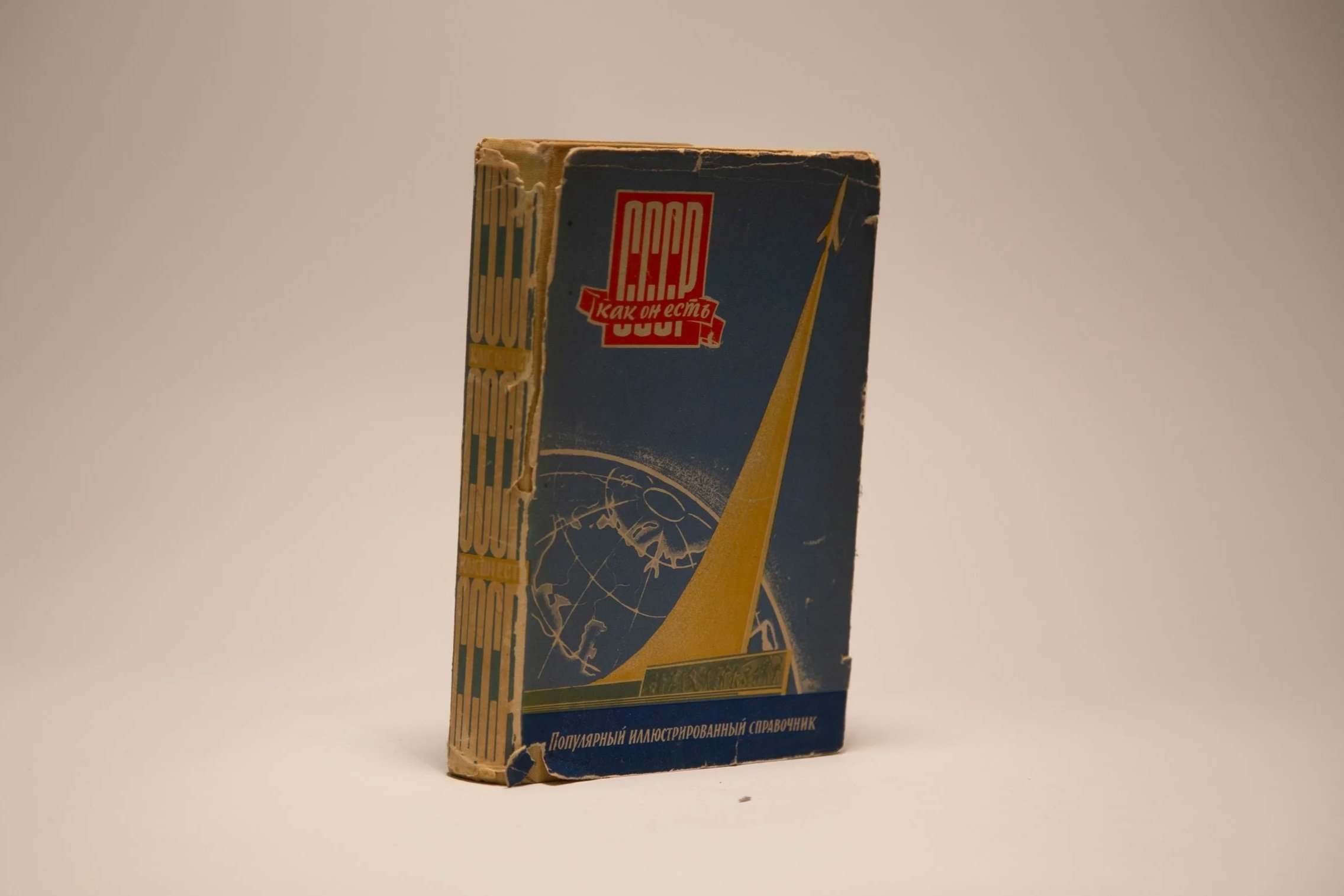
BIBLIOGRAPHIC REFERENCE: Shakhnazarov, G., and M. A. Lebedeva. SSSR Kak on Estʹ; Populi︠a︡rnyĭ Illi︠u︡strirovannyĭ Spravochnik. Gos. Izd-vo Polit. Lit-Ry, 1959.
This is a government-produced illustrated reference book about the Soviet Union, published in 1959 by State Political Literature, with infographics and data about the economy and society. It was given as an ironic gift by a Russian to an American visitor to Moscow in 1991.
By 1991, the book’s contents were not only out-of-date, but would have been officially discredited through several iterations of policy change. It was published during Krushchev’s years of reform (1954-64). Policymakers in the post-Stalin focused on how to “change the regime without destroying it.” The book’s publication occurred during a time when Soviet leaders shifted priorities in economic management and absorbed millions of newly released prisoners from the Gulag system as the Stalin terror ended. Cold War tensions eased. Industrialization emptied rural areas, and the growth of higher education was creating a new class of urbanized middle class who were less prone to manipulation. Interesting for historians of the period is the degree to which Stalinism persisted. At the time of the book’s publication, his body still lay in state alongside Lenin’s in Red Square. It was removed in 1961 and buried at the Kremlin Wall.
The book is a snapshot of this period.
The book starts with information about the size of the country, saying it is the largest in the world by territory, stretching over 11 time zones. The authors note it is almost three times the size of the US, seven times the size of India, 60 times the size of Japan, and 700 times the size of The Netherlands. Neighbors in Europe were named as Norway, Finland, Poland, Czechoslovakia, Hungary, and Romania. Neighbors in Asia were listed as Turkey, Iran, Afghanistan, China, Mongolia, and Korea.
The highest point in the country was given as Stalin Peak, at 7,495 meters, in the Pamir Range of modern Tajikistan. In 1962, the summit was renamed Communism Peak as part of Krushchev’s de-Stalinization campaign. Since 1998, it has been known as Ismoil Somoni, named for one of the country’s founding fathers (Альпинисты).
A chart of the manufacturing labor force in 1913-1957 showed the USSR at four times the rate of the next highest, the US, followed by England. Next to the infographic is the quote: “Labor productivity,” Lenin taught “Is ultimately the most important for the victory of socialism.”
In 1991-93, there were already hints of nostalgia fomenting. According to Svetlana Boym’s definition, nostalgia is “a sentiment of loss and displacement” as well as “a romance with one’s own fantasy.” Even as many embraced glasnost and perestroika, the act of gifting this book ironically shows a desire to calibrate the degree of what had changed, and the acknowledgement of something irrevocably lost.