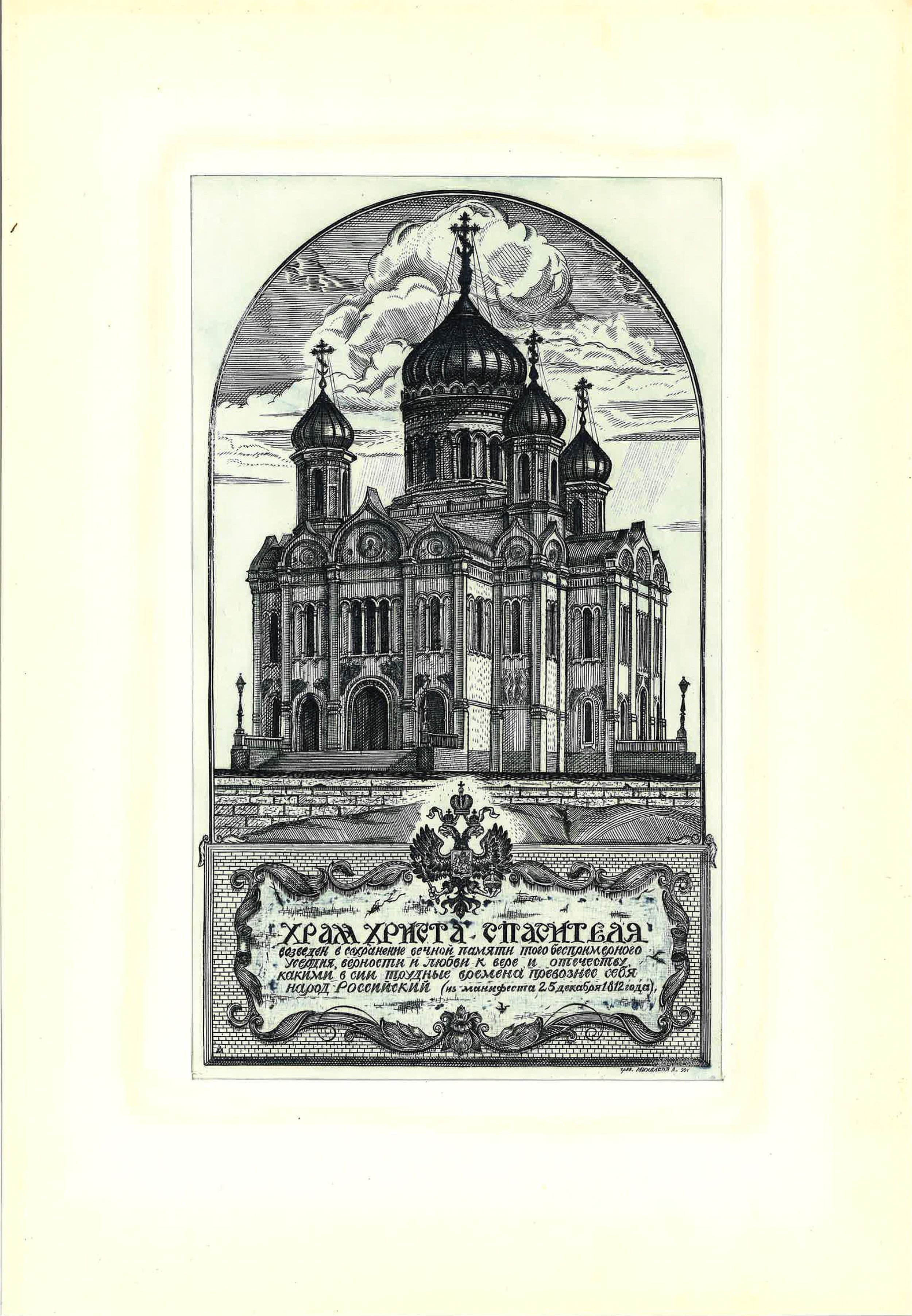
BIBLIOGRAPHIC REFERENCE: Mikhalenya A. The Cathedral of Christ the Savior, 1990.
This illustration of the Cathedral of Christ the Savior was drawn before the cathedral’s reconstruction. Dated 1990, it was a rendering of the yet-to-be-built cathedral, purchased at an outdoor market in Moscow in 1991. At the time the drawing was made, the site was occupied by the Moscow Pool, the world’s largest outdoor heated swimming pool. Builders laid a foundational cornerstone for the cathedral reconstruction in 1990, at the eastern side of the pool, so plans to rebuild would have been underway at the time of this drawing.
Beginning in the late glasnost period, calls grew louder to rebuild the Cathedral, which Stalin demolished in 1931. Especially vocal were religious groups, historical preservationists, the elderly, nationalist groups, and citizens who were eager to “resurrect an icon of the country’s past glory” as nostalgia intensified for pre-Bolshevik symbols.
Tsar Alexander I commissioned the church to commemorate the defeat of Napoleon in 1812, which had left large parts of Moscow in ruins. The cathedral’s sanctification ceremony in 1883 was the world premier of Tchaikovsky’s 1812 Overture, which the composer wrote to mark the day. The cathedral held daily services in the years prior to the 1917 Revolution.
Archives opened in the glasnost period revealed that Viktor Balikhin first proposed destroying the Cathedral in 1924 and replacing it with a monument to Lenin, who had died that year. A structure representative of the new society and Soviet power emerged from a competition, called the Palace of Soviets, which received approval in February 1931. On December 5, 1931, authorities demolished the cathedral in front of an audience of thousands. In January 1935, work began on the palace, which would have been the world’s tallest structure, comprised of a dome that housed auditoriums and rooms with capacity of 21,000, surrounded by the world’s largest plaza.
The start of war in June 1941 halted construction of the Palace of Soviets, building materials were repurposed for military use, and the site was abandoned. In the late-1950’s, under Khrushchev, the site was transformed into the swimming pool.