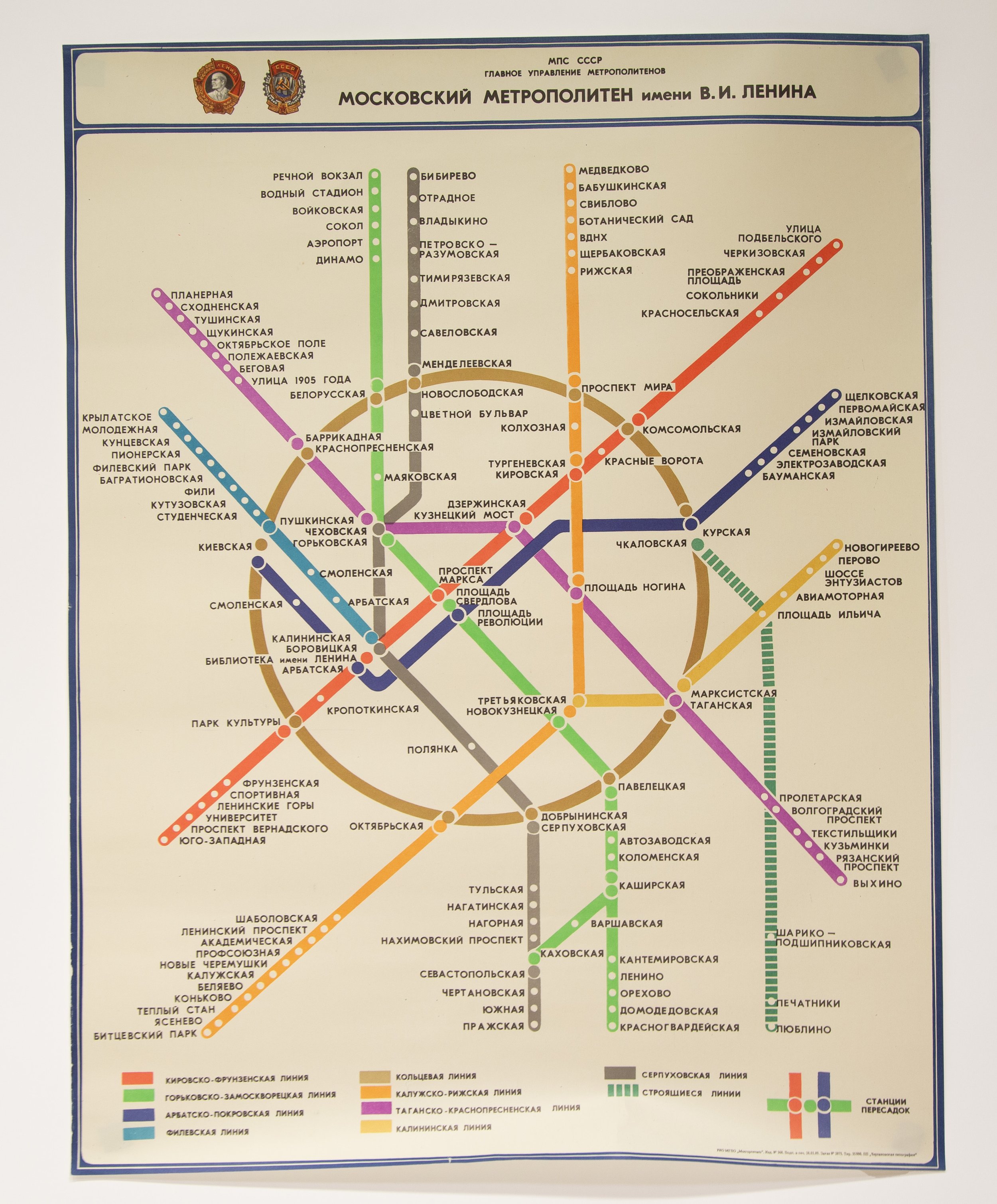
BIBLIOGRAPHIC REFERENCE: Moskovskii Metropoliten Im. V. I. Lenina, 368th ed., MPS SSSR Glavnoe Upravlenie Metropolitenov Mosgorpechat’, 1989.
In 1990, Moscow’s metro changed station names, eliminating certain references to Soviet historical figures and symbols. New station names generally became geographical reference points or reverted to old names. Sold as a discounted vintage relic at a Moscow stationary store, this map was out-of-date by 1991.
In the Soviet period, renaming places was common, with changes typically directed at reflecting regime changes or substituting tsarist references with Soviet heroes, ideals, and dates. The early 1990’s was a frenzied period of changes. With enthusiasm at a peak for moving away from the Bolshevik past, a decision in 1990 at the Moscow City Soviet level prompted changes of ten metro stations, as well as city squares and streets. By the end of 1993, 152 streets in Moscow had changed names. The pace of the early changes of the 1990’s did not continue. In a sign of building nostalgia, later attempts to change familiar names were met with public resistance.
On this map, at the center of the red line, is the station Prospekt Marksa, named in honor of Karl Marx, which changed to Okhotnyi Riad (Hunter’s Row). The green station southeast and adjacent to it, Sverdlova Square (Ploshchad’ Sverdlova), named after Yakov Sverdlov, a planner of the October 1917 revolution, who became leader of the nascent nation and also gave the order to execute the Romanov imperial family, changed to Teatral'naia (Theater), which was the site of the Bolshoi, Maly, and Moscow Arts Theaters.
Adjacent to that station is Revolution Square, which kept its Soviet-era name. North of these stations is Dzerzhinskaia, named after the head of Soviet security agencies that were the predecessors to the KGB, Felix Dzerzhinsky, which was renamed Lubianka, a name synonymous with the notorious secret service prison at the site.
The station and street named after Soviet writer Gorky (Gor'kovskaia), at the city’s preeminent commercial thoroughfare, became Tverskaya. Nearby stations also named after writers, Pushkin and Chekhov, kept their names.
The Moscow metro is a of national pride for Russia. Considered an architectural and artistic achievement when it opened in 1935, the system has modernized and expanded during the Putin era to become a jewel among world cities, with palace-like stations adorned with marble, gold, and mosaics. In a reflection of the metro system’s world-class status, Vladimir Putin sought to show Chinese President Xi Jinping the outer circle line of the Moscow metro during a 2023 state visit, pointing out that the new 70-km (43-mile) metro line was the world’s largest—longer than Beijing’s metro circle line. Of course, that second circle line is not shown on this map.