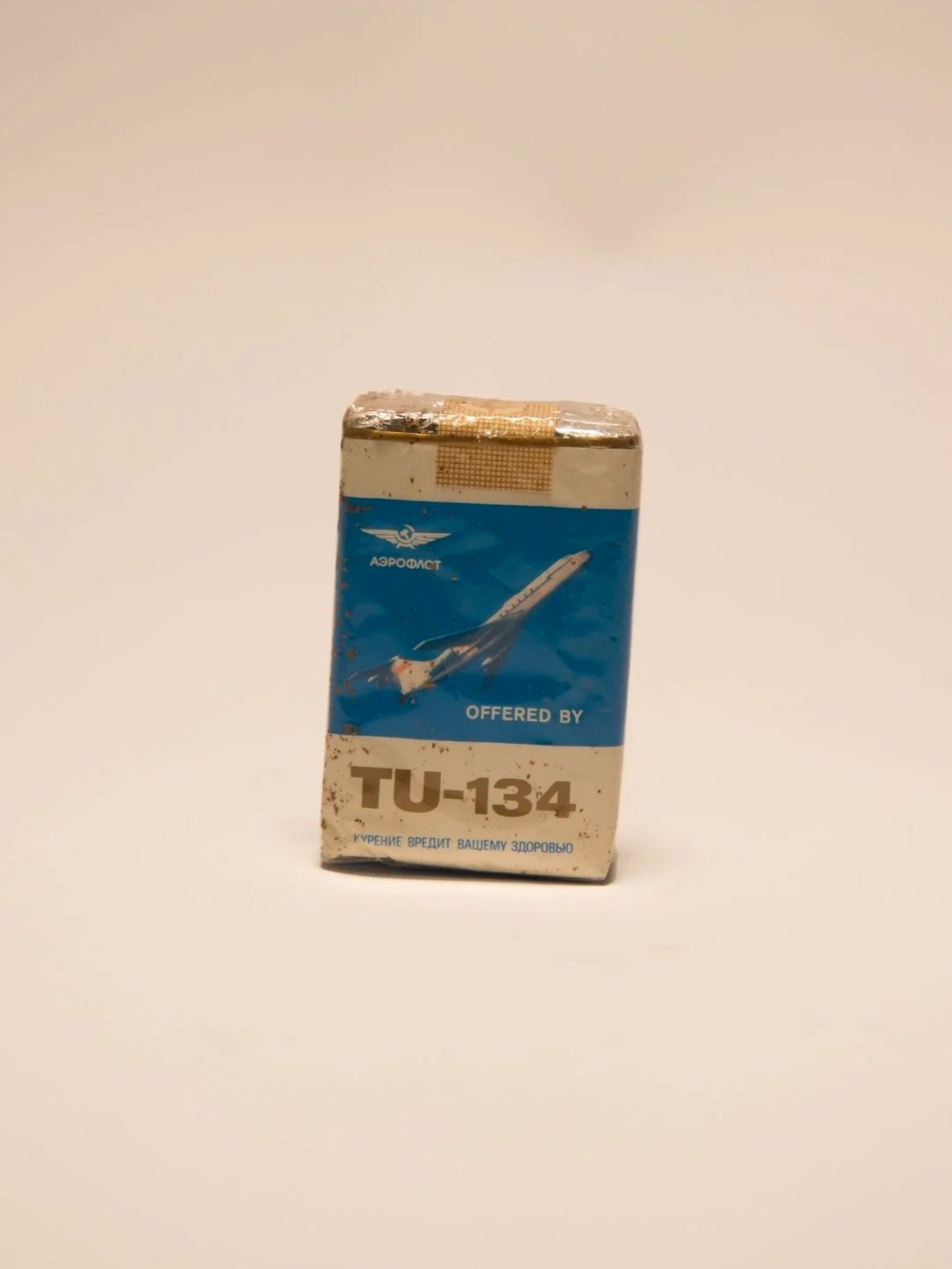
BIBLIOGRAPHIC REFERENCE: TU-134 filter cigarettes were offered by Aeroflot and made in Bulgaria, according to the label.
This is a pack of cigarettes available to passengers onboard an Aeroflot flight between Chicago and Moscow in 1992. By any modern barometer, a pack of cigarettes distributed on a commercial airline flight is anachronistic. In the early 1990’s, smoking was still allowed even on US international flights.
The glasnost period and early 1990’s opened the Soviet Union and its successor states more widely to international visitors. Many arrived via Aeroflot, the national carrier of the Soviet Union and later of Russia. Aeroflot flights stopped for refueling at Ireland’s Shannon, the most western non-NATO airport, due to a 1980 agreement between the airline and the Irish government, before continuing onward to Chicago, New York, and Washington DC, as well as Miami and Havana.
Responsible for all civil aviation, Aeroflot historically operated exclusively with Soviet aircraft. In 1992, Aeroflot began flying foreign-made aircraft such as Airbus and Boeing.
The cigarette pack shows the Tupolev TU-134, which was the first Soviet aircraft to receive ICAO (International Civil Aviation Organization) certification, allowing it to fly internationally. Its first international flight was from Moscow to Stockholm in 1967. The following year, LOT Polish Airlines, Malev Hungarian Airlines, and East Germany’s Interflug purchased the aircraft, making the aircraft a common sight in Europe. It was one of the most popular Russian-produced aircraft until noise regulations outlawed it at European airports starting on January 1, 2008. Russian domestic air carrier Alrosa was one of the last airlines to use the aircraft, phased it out in 2019. At the time, airlines in North Korea and Syria were still registered as using this aircraft.
In 1988, US lawmakers banned smoking on flights of two hours or less, initially exempting international routes and flights operated by foreign aircraft. These bans expanded in the US first, and later in Europe. Beginning from January 1, 1995, Delta Air Lines was the first US carrier to ban smoking on international flights. Aeroflot remained one of the world’s most accommodating airlines for smokers, allowing smoking on international flights after other carriers outlawed it. In 2001, Aeroflot received a waiver to the US smoking ban, allowing the airline to let passengers smoke on its flights of over three hours, including on international flights to the US. That same year, Aeroflot expanded its own rules preventing smoking on its flights, and has since banned smoking on all of its flights.