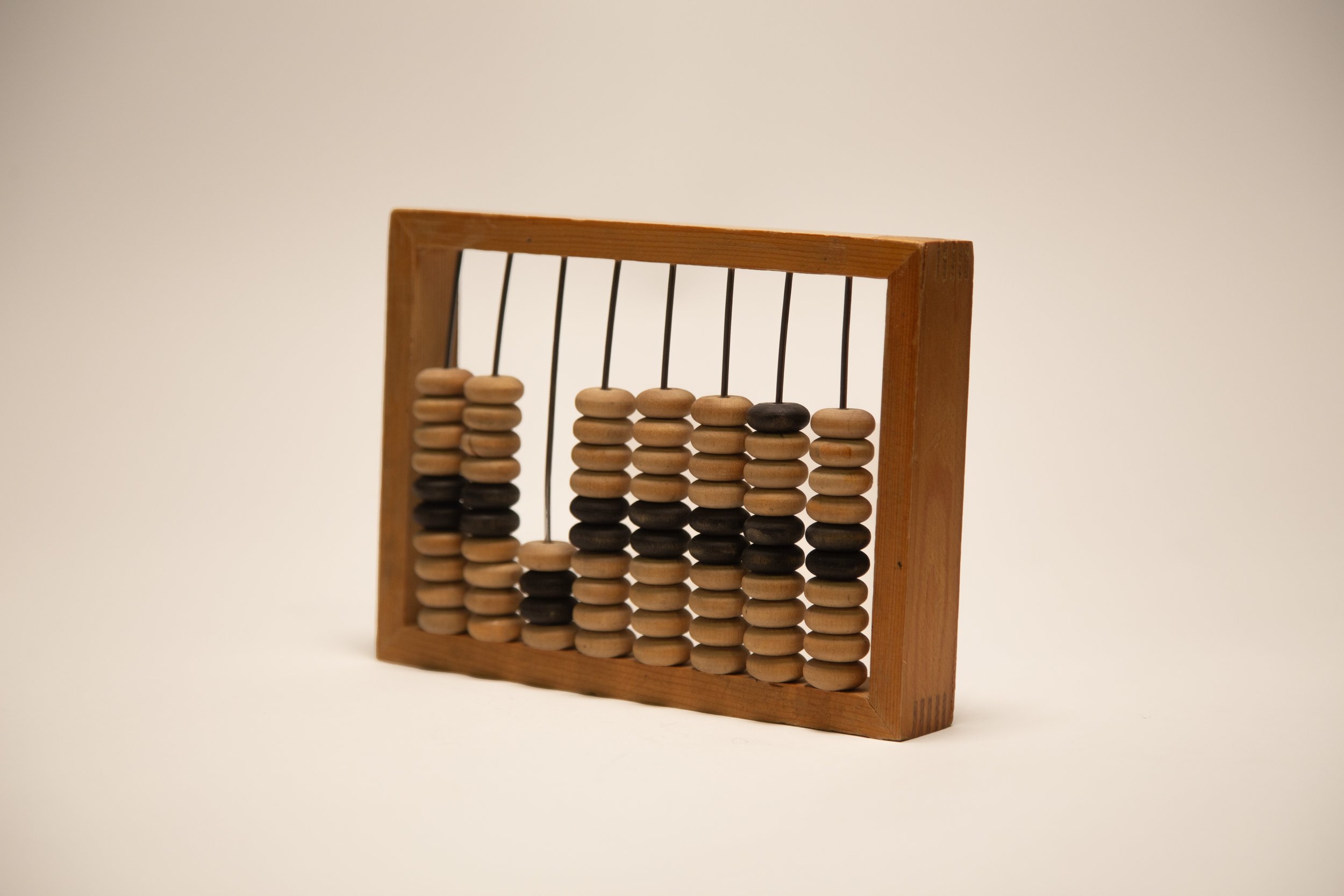
Visitors to Russia in the late Soviet years and early 1990s were surprised at vast differences in consumer goods, technology, and standards of living. For many, Soviet everyday reality upended preconceptions about the Soviet Union as a formidable, ominous military power. Store shelves were completely bare in many cases, and clerks used an abacus (счеты) like this one to calculate shoppers’ purchases.
Significant differences between standards of living in the US and USSR were in sharp relief at the “kitchen debate” at the US National Exhibition in Moscow in 1959, which marked the beginning of expanded cultural exchanges. Following an equivalent Soviet exhibit in the US, Secretary Khrushchev and Vice President Richard Nixon met in Moscow at a technology showcase of American consumer goods, cars, agricultural equipment, and a model kitchen and debated capitalism and communism. Soviet visitors to the exhibit saw the Polaroid camera, color television, and tested cosmetics. Khrushchev received a sample of Pepsi, in a Dixie Cup, an incident that led to wide distribution of the soft drink in the Soviet Union and a long-term commercial lead over rival Coca-Cola. It was considered a turning point in US-Soviet relations.
In 1958, at the first educational exchange at Columbia University, the Russian Institute received the first cohort of Soviet students at a modest reception, followed by an impromptu subway ride and visit to Times Square. Students enjoyed relative freedom and were invited to faculty homes and other students’ homes. This was in contrast to US students in the Soviet Union, for whom rules were more restrictive, in part due to poor facilities.