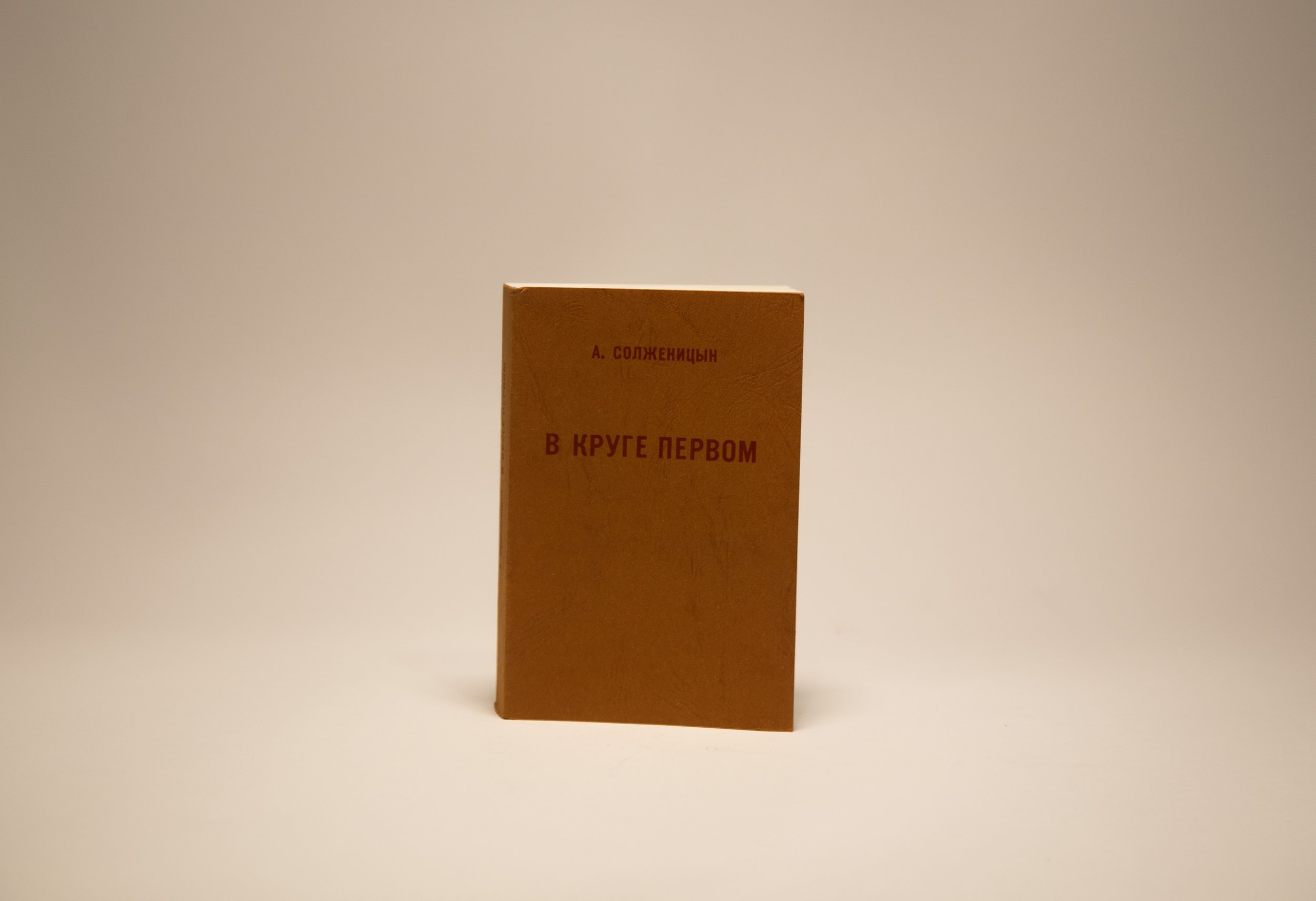
BIBLIOGRAPHIC REFERENCE: Solzhenit︠s︡yn, Aleksandr Isaevich. V Kruge Pervom: Roman. YMCA-Press, 1989.
YMCA-Press was an important source of tamizdat, which was forbidden Soviet literature published overseas that was regularly imported to the Soviet Union for domestic readers. Although no longer outlawed in 1991, Solzhenitsyn would not have been readily available by domestic publishers. Thus, attractive YMCA-Press editions were sold openly at street markets in Moscow in the early 1990’s. In addition to Paris, this volume lists Vermont as place of publication, in reference to Solzhenitsyn’s US home.
The GULAG system, named for an acronym of Main Administration of Camps, was an institution that reported to security services. The population of the Soviet penal system expanded to a post-World War II peak of over 2.5 million in 1950 that included veterans suspected of being traitors. The Gulag system included centrally located transit prisons, corrective labor camps, hard labor camps, special camps, and scientific research camps covering a wide geographical range across the Kazakh steppe to Siberia to the Far East and connected by various transportation means.
There are notable accounts of survivors of the Gulag system, including Solzhenitsyn’s “genre-defining tome” The Gulag Archipelago. Solzhenitsyn was a “58er” in reference to the article in the criminal code they broke for counter-revolutionary activity. In the First Circle, considered semi-autobiographical, is about a group of prisoners in a sharashka, a technical research facility, who work on scientific endeavors under extreme pressure and threat of being sent to other camps where conditions are worse.
Solzhenitsyn was awarded the Nobel Prize in Literature in 1970, but could not accept the award in Stockholm due to fear he would not be allowed to return home to Moscow. He was arrested in 1974 and deported to West Germany, before settling in Cavendish, Vermont in 1976. In the early 1990’s, there was talk of Solzhenitsyn’s return to Russia, with some regarding the event as an important milestone for the country, including references to the author’s return to his homeland as akin to the “second coming of Christ.” He returned in 1994, after 20 years in exile, arriving in Vladivostok and traveling by train across the country. He settled outside Moscow. By the time of his death, in 2008, his legacy was mixed, with Russian people praising him for his contributions in exposing Stalin’s Great Terror to the world and some critical of his embracing of nationalism late in life.