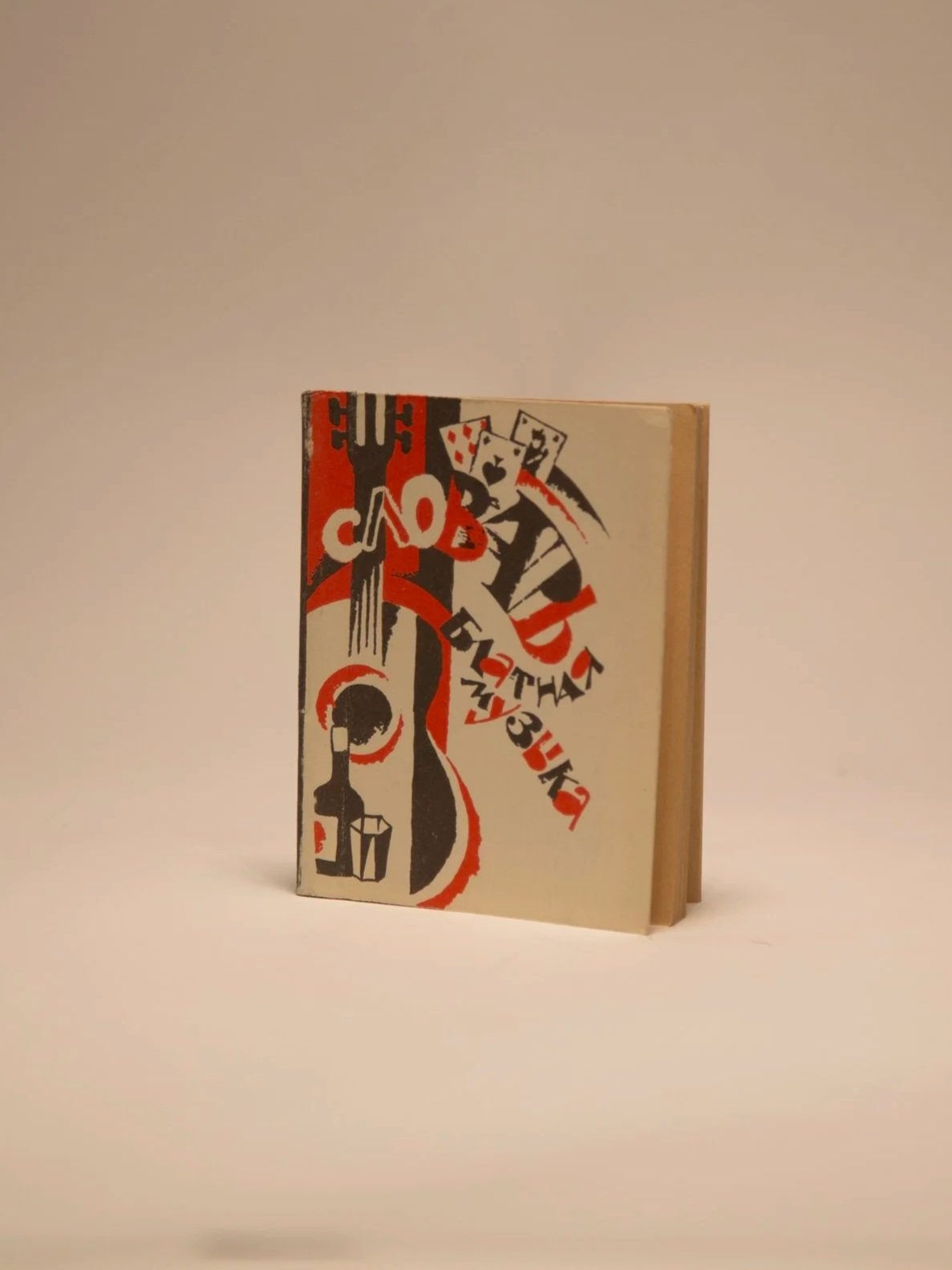
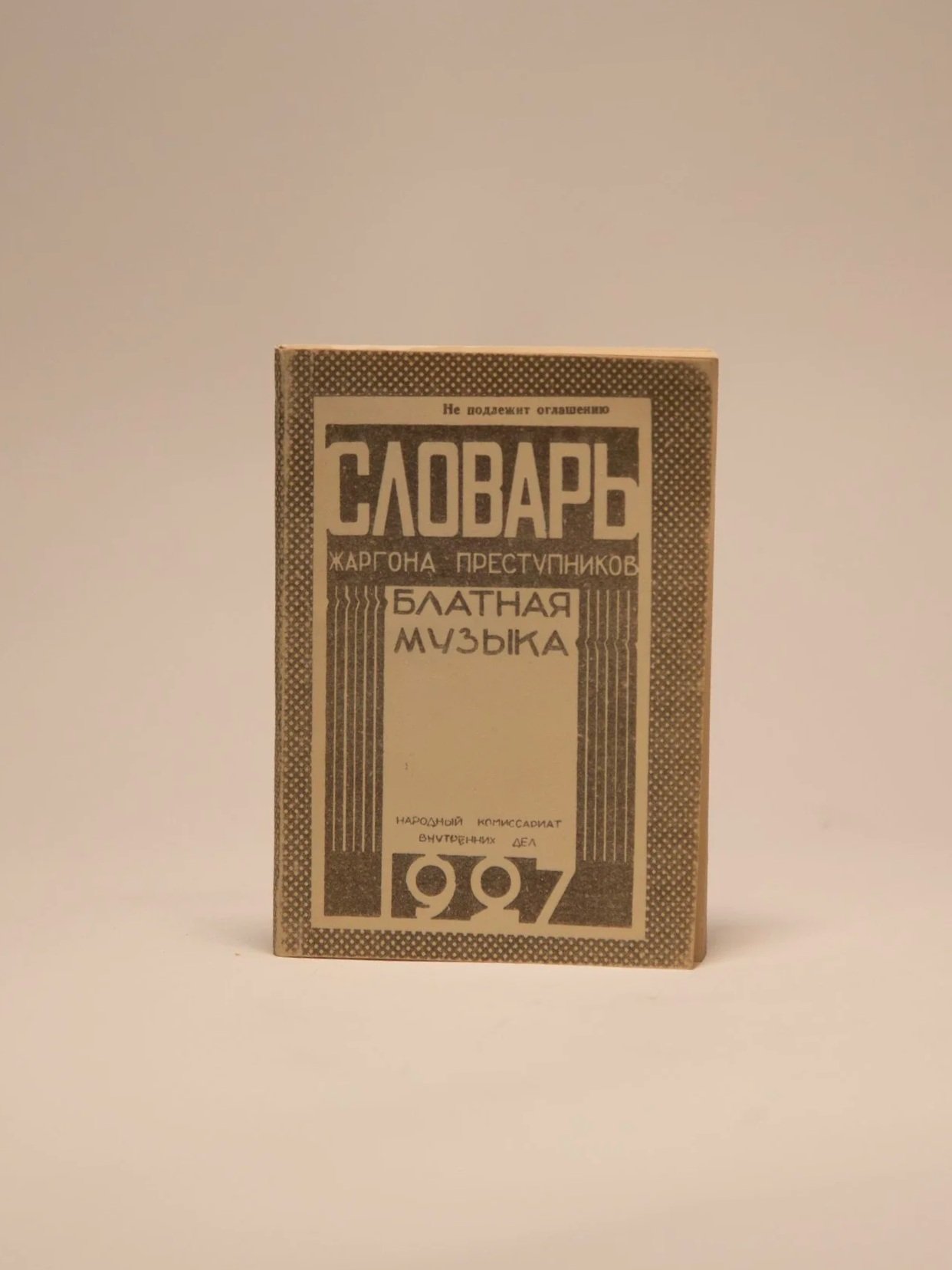
BIBLIOGRAPHIC REFERENCE: Potapov, S. M. Slovarʹ Zhargona Prestupnikov: Blatnaia Myzyka. BLIK, 1990.
These small paperbacks are dictionaries of slang and jargon of criminals from the mid-1920’s. Both versions were printed in 1990 on uncoated lightweight paper, and have identical content, a word list compiled by S.M. Potanov, with an introduction by him. Only the covers differ. One has a black-and-red design of a guitar, playing cards, and alcohol--accoutrement of the incarcerated, and is shown to have a circulation of 50,000 and sold for five rubles, according to its cover page. The second has a simpler, one-color cover with an art deco design including the year 1927. This had a larger circulation of 200,000. During the early 1990’s, book publishers, like other previous state enterprises, were forced to find their own customers. They sought to bring titles to the market, particularly, popular easy-to-read forms.
“Criminal music” or “thieves’ cant’” (блатная музыка) was the “vernacular between criminals.”. Criminal and penal slang became a subject of public interest in the 1990’s. The surge in interest in the 1990’s mainstream coincided with post-Soviet increase in crime and crime reporting. An increase in slang, “colloquial forms,” obscenities, and foreign words began in the glasnost period, when “stylistic uniformity in the media fell off sharply,” and new concepts demanded new language and nomenclature.
Between 1923 and 1930, Solovki grew to around 65,000 prisoners, becoming the largest and most important prison to the Bolshevik regime. Previously the site of religious pilgrimage, the Solovki camp, on the White Sea, became a “showpiece” of “hard labor and prisoner re-education” and even received foreign dignitaries.
There are some accounts of survivors of incarceration during the 1920’s, but the vast majority are memoirs of the Gulag system, including Solzhenitsyn’s “genre-defining tome” Arkhipelag Gulag and the memoir of Eugenia Ginzburg. Solzhenitsyn and Ginzburg are “58ers” in reference to the article in the criminal code they broke for counter-revolutionary activity.
The work of prisoner and literary figure Boris Glubokovsky focused on Solovki where he served a 10-year sentence following his arrest in 1924. In addition to helping stage plays and working on a prison newspaper, Glubokovsky published 49, in reference to their criminal code, focusing on “49ers,” that encompassed those sentenced for being “socially dangerous” or suspicion of being linked to “criminal milieu” outside the camp. This group, were typically illiterate, male ethnic Russians.
Others have also documented criminal subculture lexicology, such as a 1908 publication of Blatnaia Muzyka compiled by V.F. Trakhtenberg, who collected over 700 entries from prisons in Warsaw, Vilna, St Petersburg, Moscow and Odessa. Former inmate Jacque Rossi compiled a dictionary of camp slang based on his experience beginning in the late 1930’s until mass amnesties upon Stalin’s death in 1953.
Prison slang included terminology that described prison hierarchies, types of crimes, geographical origins of prisoners, and unofficial and official prisoner duties. For example, prisoners named Ivan were numerous at Sakhalin Island, an imperial island prison. The dictionary defines “Ivan” as “бродяга” a tramp or vagabond, who is “hiding his actual name.”