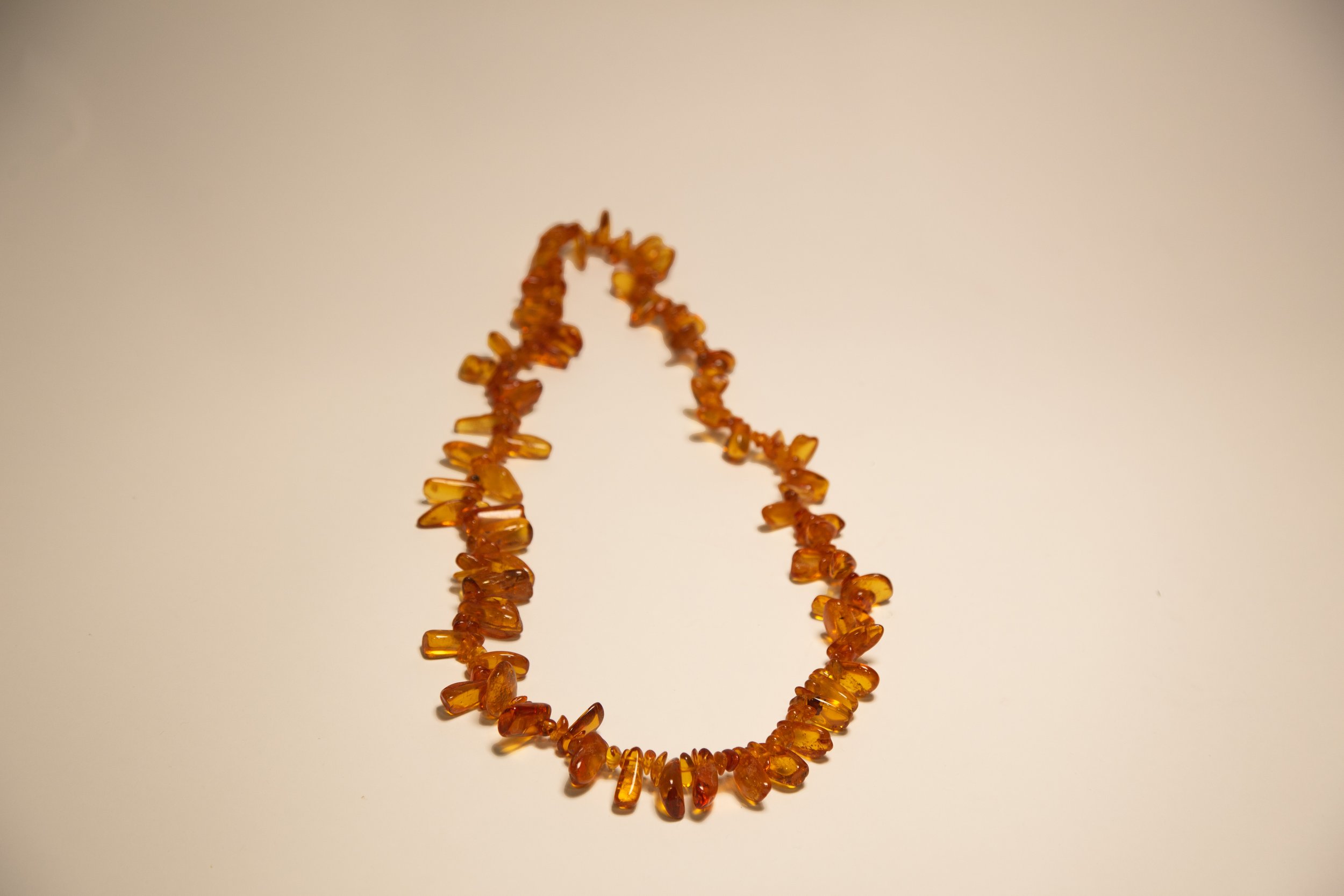
A 16 in. (40 cm) necklace of irregular amber stones purchased in 1993 in St. Petersburg. It is a typical souvenir bought at any tourist area in Russia. It is a prized commodity and luxury product linked to Russia’s Imperial past and symbolic of the reaches of Soviet “empire.”
Amber is often associated with the coastal area of eastern Baltic and the Sambia Peninsula, which includes modern Kaliningrad, Lithuania, Latvia, and Estonia. An area in northwestern Ukraine has become the source of amber that is illegally extracted and sold on through the black market. Traditionally fashioned into rosaries, religious artifacts, and altars by craftsmen, more pedestrian examples of jewelry from the material are commonplace in Russia’s tourist areas.
Amber, which is fossilized tree sap, is also an important source of fossil remains, and thus a record of natural history, since it preserves insects and plant remains “with microscopic fidelity.”
The material holds an esteemed position in Russian architectural history. An Amber Room in the Catherine Palace outside St. Petersburg was looted by Nazi soldiers, prompting a decision in 1979 to restore it. It reopened in 2003, in time for the 300th anniversary of St. Petersburg.
Populist movements in support of perestroika emerged in Lithuania, Latvia, and Estonia, and the three republics posed a particular problem for Gorbachev in keeping the Soviet Union intact. Lithuania’s parliament declared independence in March 1990, while Latvia and Estonia declared “transitional periods” to independence from the Soviet Union. In January 1991, troops mounted a short-lived special operation in Lithuania, resulting in 13 deaths. Following the failed coup of August 1991, Gorbachev “recognized the independence of Lithuania, Latvia, and Estonia.”
Lithuania’s Museum of Amber, founded in the 1960’s and located in the resort town of Palanga, made an intentional effort to connect modern Lithuanian nationhood to the land’s natural history and amber production.