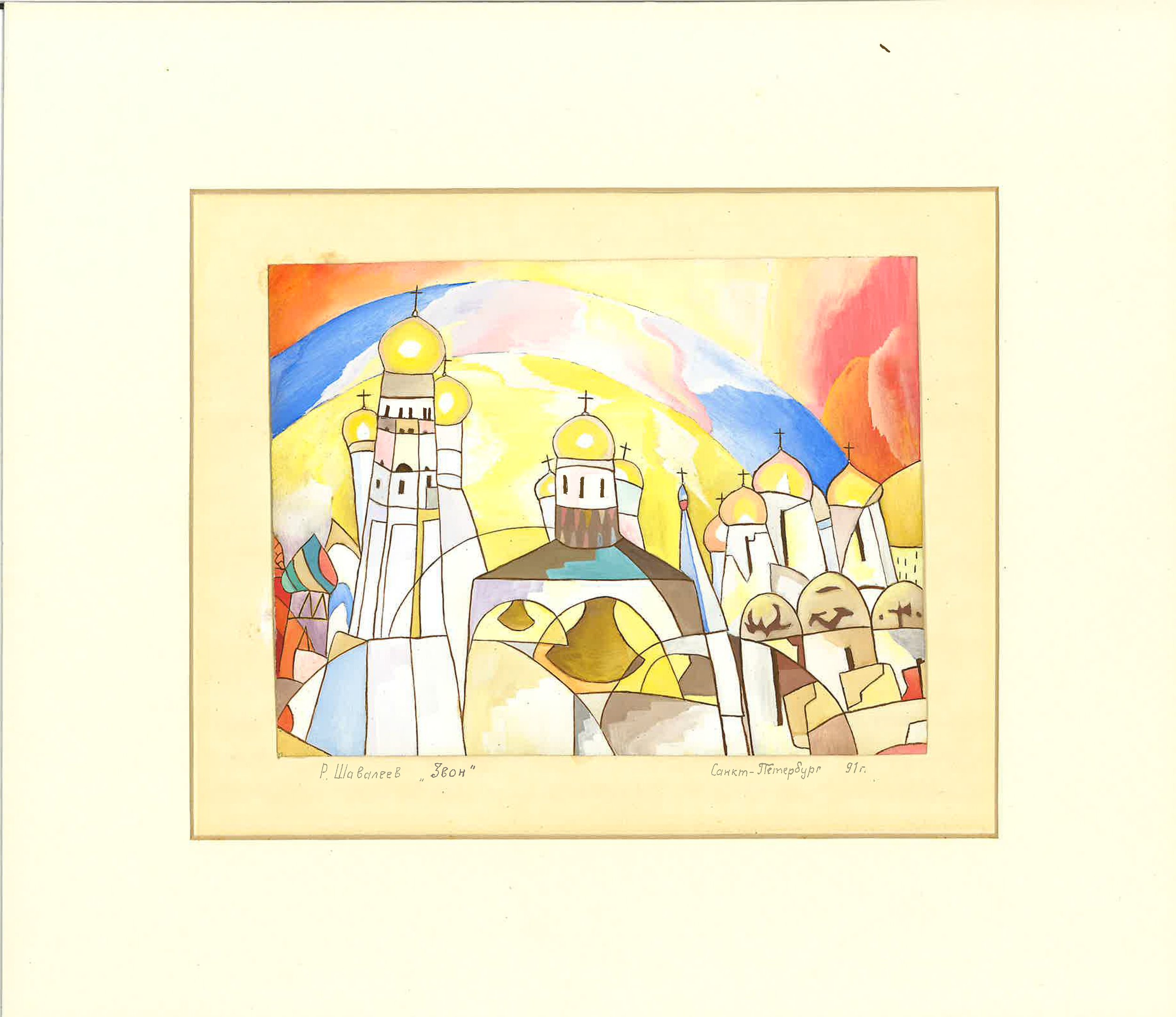
This is an acrylic painting of Orthodox church cupolas in St. Petersburg, entitled “Bell,” by R. Shavaleev, signed St. Petersburg and dated 1991. It was sold at an outdoor street market in Moscow in 1991.
Communism was a “quasi religion” during the Soviet period. After the end of the Soviet Union, a “massive and rapid restoration” occurred of religion’s institutional and social base.
Russian Orthodoxy, Islam, Protestantism, and shamanism offered “some of the first possible alternative moral discourses and practices after the end of the Soviet system.” Well-organized proselytizing Protestant groups penetrated Russia after the end of the Soviet Union and indiscriminately provided aid and charity to the public. These groups offered material goods, Bibles, as well as social and travel opportunities.
New religious movements started, coinciding with the Soviet Union, that included “New Age beliefs, utopian expectations, and totalistic forms of social control.” One of these was the Last Testament Church, founded by Sergey Torop, following a self-professed spiritual epiphany in 1991. Torop renamed himself Vissarion and he claims to be a messiah.
In the early 1990’s, the Russian Orthodox Church came under criticism for “lack of morality during the Soviet period” and “appeasement of Soviet power.” The Church’s “moral standing” has been restored in the ensuing years through a new narrative that includes religious martyrs during the Bolshevik regime, canonization of faith leaders who upheld beliefs in the time of Stalin’s Great Terror, and the glorification of the Tsarist Romanov family.